![[personal profile]](https://www.dreamwidth.org/img/silk/identity/user.png)
After booking my holiday, it occurred to me that Sorrento and Naples are not too far from Rome, where my friend Nathalie lives, and when I got in touch with her it tur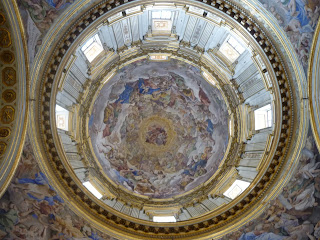 ned out that she was free on Monday, so we were able to arrange to meet up. Nathalie generously agreed to come to Naples, and as Monday was my last full day, and I had a very early flight home on Tuesday morning, I'd booked a hotel in Naples for Monday night, so I travelled from Sorrento and checked in there, and Nathalie travelled from Rome, and we met in the lobby.
 ned out that she was free on Monday, so we were able to arrange to meet up. Nathalie generously agreed to come to Naples, and as Monday was my last full day, and I had a very early flight home on Tuesday morning, I'd booked a hotel in Naples for Monday night, so I travelled from Sorrento and checked in there, and Nathalie travelled from Rome, and we met in the lobby.
The weather had broken overnight - I was woken at 2 a.m. by a tremendous thunder storm - I thought for a moment the hotel was falling down around me! the rain lowered the temperature, which was nice, and it also meant it was a little clearer, although not by as much as I would have expected.
We set out to explore Naples - we started with the cathedral of San Gennero, as it turned out it was the day for the annual miracle, when some vials of St. Gennero's blood are brought out of the bank-vault in which they are normally kept, and the dried blood inside 'miraculously' liquefies. As a result, the church was very full, overflowing with nuns, and men in cassocks, and local dignitaries; we saw the tail-end of the procession going to the Church, but didn't wait for the miracle itself (although I gather this took place as advertised!)
 |
| 'Dissillusion' (Pic from museum website) |
We also visited the Cappella Sansevero, which houses a very famous sculpture of the 'Veiled hrist'. Unfortunately they have a very strongly enforced 'no photography' rule - however, the sculpture is incredible - really gives the mpression of a body covered with a veil, through which details such as the wounds on the hands and feet can clearly be seen. The veil itself has delicate carved lace along the edges.
 The sculpture is in the entre of the chapel, which also contains a number of other statues all having allegorical meanings, and with many references to freemasonry. To me, the most impressive is the statue depicting disillusion, which has intricately carved stone
netting!
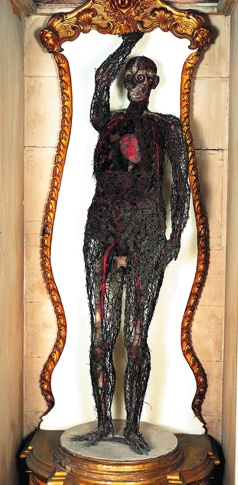
Below the main chapel, is a smaller chamber which contains two 'Anatomical Machines' which consist of two human skeletons, male and female, showing all the veins and arteries, and at least some of the internal organs.
These were made in the 1760s, and no-one is entirely sure how they managed to do it. One theory is that it was done by injecting something, but according to the reading I've done since, it's now believed that the circulatory systems were made using wire, and plaster and beeswax, but it is still an incredible achievement - not least as it displays a much more accurate depiction of the circulatory system than was thought to be current at that time! The two bodies are looking somewhat the worse for wear, but very interesting, in a slightly gruesome way.
 The sculpture is in the entre of the chapel, which also contains a number of other statues all having allegorical meanings, and with many references to freemasonry. To me, the most impressive is the statue depicting disillusion, which has intricately carved stone
netting!
Below the main chapel, is a smaller chamber which contains two 'Anatomical Machines' which consist of two human skeletons, male and female, showing all the veins and arteries, and at least some of the internal organs.
These were made in the 1760s, and no-one is entirely sure how they managed to do it. One theory is that it was done by injecting something, but according to the reading I've done since, it's now believed that the circulatory systems were made using wire, and plaster and beeswax, but it is still an incredible achievement - not least as it displays a much more accurate depiction of the circulatory system than was thought to be current at that time! The two bodies are looking somewhat the worse for wear, but very interesting, in a slightly gruesome way.

 We went to the church and cloister of San Chiara, which
features a cloister with majolica tiled pillars and seats. Most of the tiles feature either daily scenes of trading or hunting, or of maginative scenes of coaches drawn by lions, or peacocks, or sea monsters. Inexplicably, the scene in which the lions turn on their grooms and devour them, llustrating why cats are not suitable for this kind of work, is omitted.
 We could only find one scene which related to the life of the convent, showing a nun feeding cats - two of which we identified as Bengals...
The church also has a small museum, in which none of the exhibits are labelled, so you find yourself looking at a mummified leg in a gilded case wondering who it (is supposed to have) belonged to.
We also visited a number of other churches, and we tried quite hard to visit Castel Nuovo, but unfortunately it was closed. It has a pretty impressive gateway, though!

 We did, however, manage to find a nice restaurant where
we ate pizza and drank beer, and later, we had coffee at Gambrinus,
which is the oldest coffee shop in Naples, and still serves excellent
coffee!
 We were also unable to return to the archaeological museum, as that, too, is closed on Mondays. We did however, pass through the Galleria Umberto I, which is a huge shopping area, built in the 1880s, and featuring lots of angels, and glass ceilings and plasterwork. As shopping
centres go, its pretty impressive.
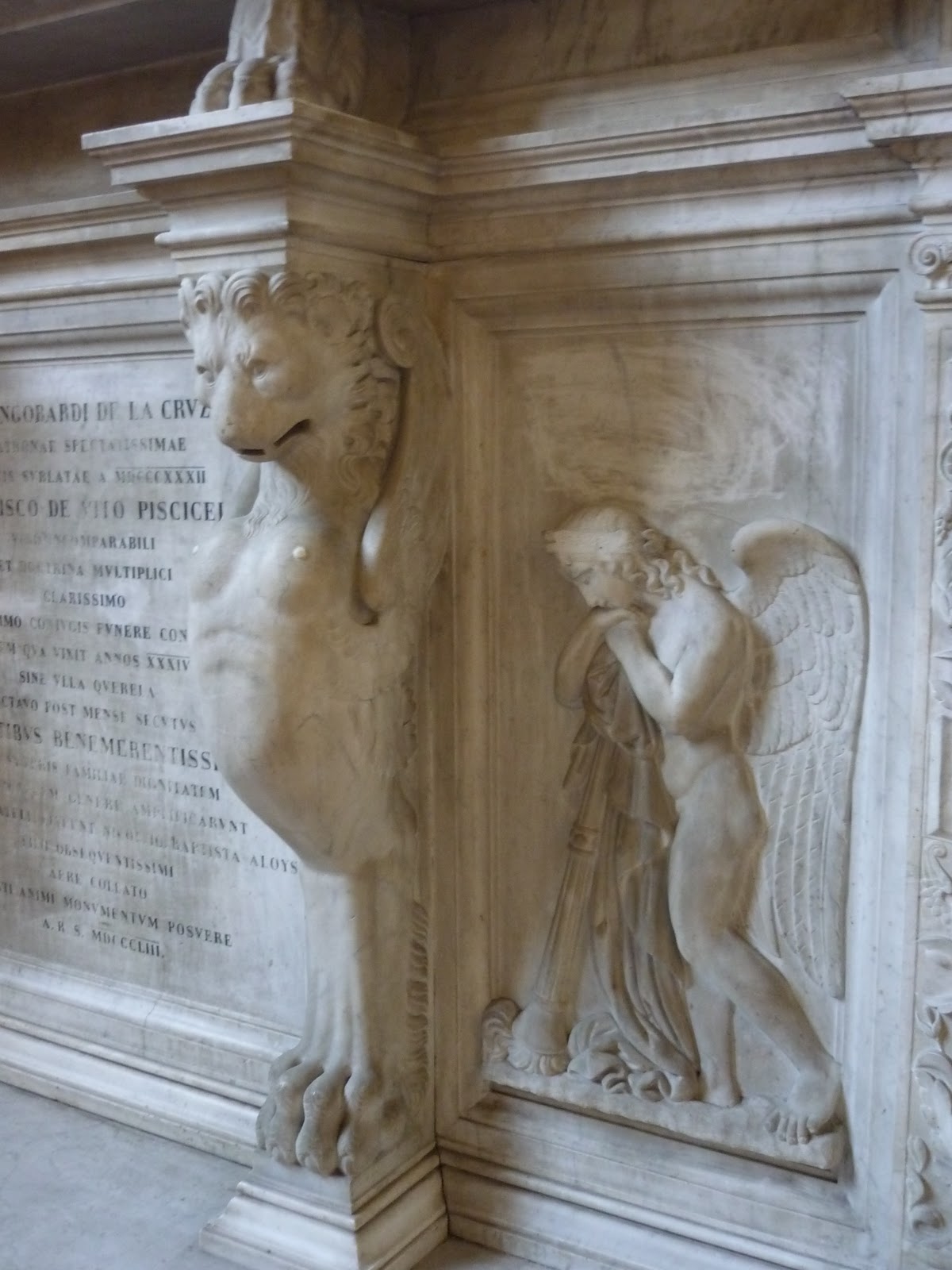 There were a few more churches, and admired some .. interesting.. pieces of sculpture. I personally have no problems with Artemis of Ephesus or with one-legged Sphinxes as part of a tomb in a christian church, but I'm curious to know how they came to be approved, and what they were deemed to symbolise to make them acceptable for such a place!
We also spent a sensible amount of time sitting drinking granita and chatting, and
simply wandering around, looking at streets and graffiti and stalls selling crib-figures, (and some figures *not* suitable for cribs, such as statues of Berlusconi and of various other celebrities and politicians.)

I really enjoyed the day - spending it with a friend made a wonderful finale to my holiday!
(Although I did realise, when i got back to my hotel, that I had forgotten to give Nathalie the jar of home-made bramble jelly I brought all the way to Italy for her...
(Although I did realise, when i got back to my hotel, that I had forgotten to give Nathalie the jar of home-made bramble jelly I brought all the way to Italy for her...
And then on Tuesday, I got up very early in the morning, and caught my flight home.